You may have heard the term ‘meta description’ thrown around before in the digital marketing world, however, you may not know exactly what a meta description is, how it can benefit your business and how to write one effectively.
What is a Meta Description?
At its base, a meta description is part of your meta HTML tags. It briefly describes the page to the user. This small snippet often appears in the search engine results under the name and headline of a page. If no meta description is given, the search engine may take text from the main body of the page instead.
What is the purpose of a meta description?
Rather than having a significant impact directly on your rankings, a meta description’s main purpose is to improve a page’s Click-Through Rate (CTR).
Click-Through Rate is the ratio of total users that click through to a given page, against the total number of users that saw the page in the search results. If you have 5 clicks and 100 impressions, your CTR would be 5%.
Effectively, after a user reads your meta description, the goal is that the user is both informed as to what the page is about and will want to click on your page. By improving your CTR, you are proving to the search engine that this is a relevant and interesting page, which over time can improve your search ranking. This means that although a meta description does not have a direct influence on a page’s search ranking, it can help improve CTR which in turn improves a page’s search ranking, therefore a meta description can indirectly influence search ranking.
How to Write a Good Meta Description
Concise and Informative
A meta description should be quick to read but be detailed enough so that the user understands exactly what they can expect to see on the webpage. This means you should try and keep things short and snappy. By keeping your meta descriptions shorter, it also means that search engines can show the full meta description in the search results, rather than only showing the first section.
Include a Call to Action
A Call to Action (CTO), is an instruction to a user-designed to provoke a specific response, such as ‘call now’, or ‘find out more’. You are trying to ‘sell’ your page with your meta description, by using a strong CTO you could well see an improved CTR.
Use Focus Keyword
By including a relevant keyword that is focused on your business within your meta description, search engines will be more inclined to show your page. As well as this, synonyms to searched queries could be highlighted depending on the search engine, which can make your page stand out even more.
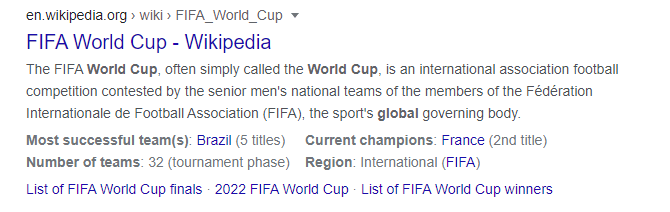
When you search ‘World Cup’ on Google, you can see this term is highlighted in the meta description, which can help grab the user’s attention.
Avoid Duplicates!
Make sure you use a unique meta description for each of your pages. By using duplicate meta descriptions, it makes it difficult for the search engine to understand the topic of your page and harms the user’s experience.
Conclusion
A great meta description explains what a page is about in a short and concise manner and also convinces the user that the page is the best returned in their search results. By creating unique meta descriptions that incorporate your keywords and include CTO’s, you can expect to see an increased CTR. By increasing the percentage of users that click through to your page, you receive more traffic and can expect to see your page move up the search rankings, increasing traffic even further.
If you’d like any help with your Search Engine Optimisation and Digital Marketing, please get in touch. We are an SEO agency in Oxford and would love to help.